
Area and visual connections
Radio cells, directional routes and mounting points are determined based on the real terrain.
Outside, distances, weather, tents and flows of visitors change the radio conditions. We connect box offices, crew, media, backstage and audience with a robust temporary infrastructure.
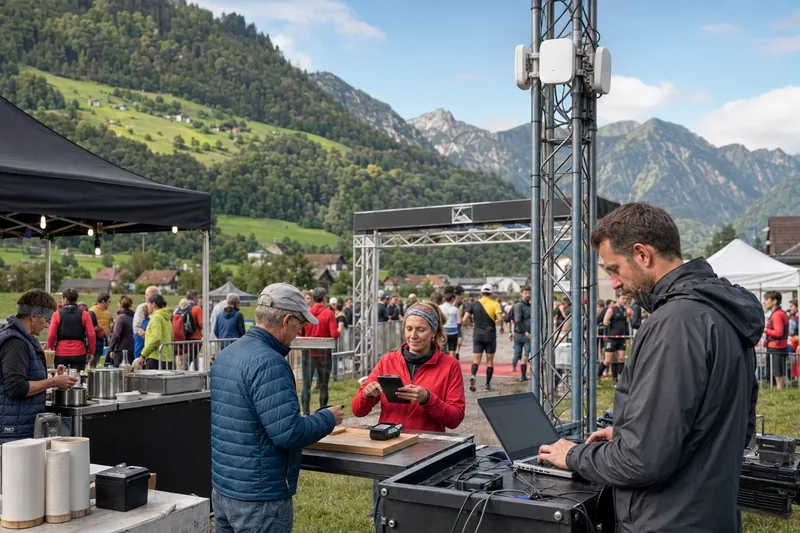
On an open area there is rarely power, network and assembly points exactly where they would be technically ideal. At the same time, tents, stages, containers and crowds change the line of sight. Planning must therefore be closely coordinated with production, electricity, security and set-up times.
Operational networks are particularly important. Mobile cash registers, accreditation, helpers, media and event management require defined connections, even if public WiFi is heavily used. These systems receive their own segments and, where necessary, prioritized fallback paths.
Every building block is adapted to the venue, schedule and risk profile.
Radio cells, directional routes and mounting points are determined based on the real terrain.
Housing, cable routes, power and mounting are designed for weather and public use.
Cash registers, access and production remain separate from the open visitor WiFi.
Monitoring and clear escalation help to identify changes early.
Before you enter, we not only check whether an access point can be reached. We test the intended user groups, internet routes, cash registers or production devices and document the most important handovers. This means that it is known which components belong to which area.
During the event, visitor movements may change radio conditions. With central monitoring, we can see utilization and quality without having to process each location individually. In particularly critical situations, an on-site technician complements the remote team.
With suitable hardware, protected connections and clean assembly, yes. However, weatherproofing does not replace radio and power planning.
Depending on the location, we check temporary lines, mobile communications, radio links or combined Internet paths.
Yes. Especially at outdoor events, operational systems are consistently segmented by public WiFi.
Location, date, areas and expected visitor numbers are enough for an initial assessment.