
Internet access and fallback routes
Landline, temporary line, mobile or combined uplinks – appropriate to the location and risk.
A stable wireless network is not created by having as many access points as possible. It arises when internet connectivity, capacity, security, cabling and operations are planned as a system.
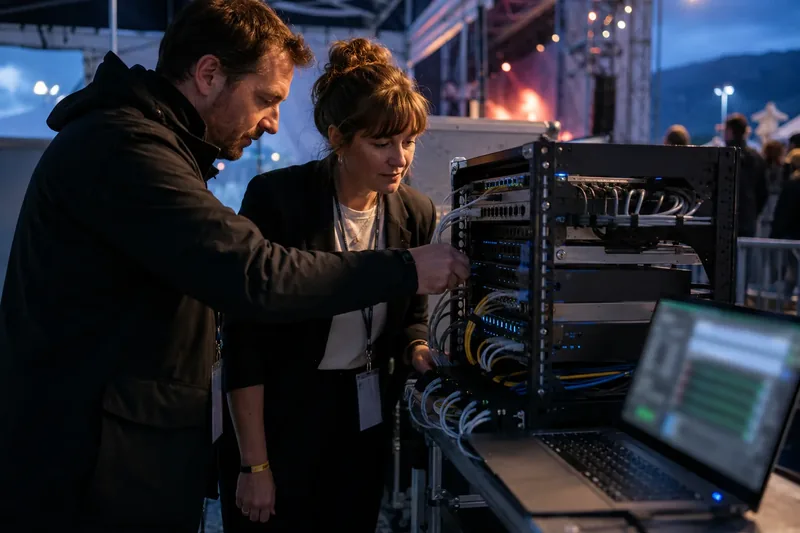
Guests expect easy connection. At the same time, check-in, cash registers, production, speakers, media and employees need reliable and separate networks. These requirements often come together in temporary spaces, on changing surfaces or under high time pressure.
novoSYS therefore first clarifies which processes are really critical. We then dimension Internet access, radio cells, switches, firewalls, power and cabling. The result is not an off-the-shelf device package, but rather a comprehensible solution for exactly this occasion.
Every building block is adapted to the venue, schedule and risk profile.
Landline, temporary line, mobile or combined uplinks – appropriate to the location and risk.
Positions, channels and transmission power are planned for area, usage and expected device density.
Guests, crew, cash registers, production and internal devices receive appropriate segments and access rules.
Configuration, assembly, testing, monitoring and support are organized before the event.
How many people are on site at the same time? Which applications run over the network? Are there live streams, cloud cash registers or digital access controls? How does the utilization change over the course of the day? And which systems have to continue working even if a connection fails?
These questions matter more than a fixed number of access points. A trade fair with many devices at exhibition stands has different requirements from a corporate event with hybrid sessions. An outdoor event needs different mounting points, cable routes and protection from a congress centre. Our planning turns these differences into a practical network design.
This depends on area, usage and device density. We size radio cells, uplink and switching based on real requirements instead of a general number of guests.
Yes, if capacity, access and responsibilities are right. We check the existing infrastructure and only add what is actually missing for the event.
Yes. Depending on the risk, we provide support remotely, with defined standby or with technical staff directly on site.
Location, date, areas and expected visitor numbers are enough for an initial assessment.